

The Four Protection Levels — NFC 17-102
According to NFC 17-102 (Ed. 2.0), every structure requiring lightning protection must be assigned one of four protection levels based on a risk assessment. The level determines the minimum protection efficiency required and the corresponding standard protection radius (r) used to size the ESE lightning rod installation.
The protection level of a structure depends on several factors: whether it is located in an inhabited area, whether the contents are explosive or hazardous, the construction material of the roof, and the value and vulnerability of its contents. The more precious and critical the structure, the higher the protection level required — and the larger the standard radius that must be achieved.
How is the protection level determined? The level is not chosen arbitrarily — it is calculated using the NFC 17-102 risk assessment methodology, which compares the expected annual strike frequency (Nd) against the tolerable strike frequency (Nc). Use the ORBITAL Lightning Risk Calculator to determine which level your project requires.
Protection Radius (Rp) — How It Is Calculated
The actual protection radius of an ESE lightning rod — designated Rp — is not fixed. It depends on three variables: the standard radius (r) for the required protection level, the advance time ΔT of the ESE lightning rod, and the installation height (h) above the structure being protected.
The formula defined in NFC 17-102 is:
Rp = √ [ h(2r − h) + ΔT(2r + ΔT) ]
Where: r = standard radius for protection level (20/30/45/60m) | h = height of ESE tip above structure (minimum 2m) | ΔT = advance time of ESE lightning rod in µs
The table below shows calculated Rp (in metres, rounded) at common mast heights h. Columns run left-to-right from Level I (r = 60m) through Level IV (r = 20m); illustrative ΔT values increase 15 → 30 → 45 → 60µs in the same direction. Your project's ΔT comes from the certified lightning rod — the formula uses both r (from the assessed protection level) and that ΔT together.
| Mast Height h | ΔT = 15µs Level I (r = 60m) |
ΔT = 30µs Level II (r = 45m) |
ΔT = 45µs Level III (r = 30m) |
ΔT = 60µs Level IV (r = 20m) |
|---|---|---|---|---|
| h = 2m | 48m | 61m | 70m | 78m |
| h = 4m | 50m | 63m | 70m | 78m |
| h = 5m | 51m | 63m | 71m | 79m |
| h = 6m | 52m | 64m | 71m | 79m |
| h = 8m | 54m | 65m | 72m | 79m |
| h = 10m | 56m | 66m | 72m | 79m |
| h = 15m | 60m | 69m | 73m | 80m |
Higher installation height always increases Rp. This is why ORBITAL recommends mounting the ESE lightning rod on a dedicated mast of at least 4–6 metres above the highest point of the structure, rather than flush-mounting on the rooftop.
Installation Case Studies
The following real-world examples demonstrate how the NFC 17-102 protection radius formula is applied in practice. Both cases use ORBITAL ESE lightning rods with verified ΔT values and show how the resulting Rp value covers the protected structure.
Project type: Large industrial warehouse requiring full roof coverage. Due to the building's width, a single lightning rod at the roof ridge was insufficient to cover the entire footprint to the required protection level.
Solution: Two COMET ESE Lightning Rods were installed at a mast height of h = 6m above the roofline, positioned symmetrically along the ridge. The standard protection radius for Level III is r = 30m, with the COMET's certified ΔT = 30µs.
Applying the NFC 17-102 formula: Rp = √[6(2×30−6) + 30(2×30+30)] = √[324 + 2700] = √3024 ≈ 55m per lightning rod. The protection radii of both lightning rods overlap at the centre of the building, providing full and redundant coverage across the entire facility.
According to ORBITAL's independent test reports, the actual protection performance of the COMET ESE Lightning Rod exceeds the NFC 17-102 minimum — meaning the standard formula provides a conservative and safe estimate.
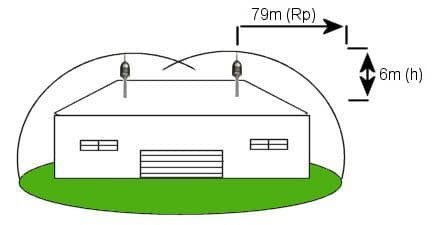
Project type: Two-storey residential building with a pitched roof. The risk assessment determined Protection Level III is required due to the building's location in an area of moderate lightning density (Ng = 2.5) and its standard construction.
Solution: A single COMET ESE Lightning Rod was installed at a mast height of h = 4m above the roof ridge. With the COMET's certified ΔT = 30µs and the standard Level III radius of r = 30m:
Rp = √[4(2×30−4) + 30(2×30+30)] = √[224 + 2700] = √2924 ≈ 54m. A single lightning rod placed at the apex of the building provides full coverage of the entire structure with significant margin — the 54m radius extends well beyond the building footprint in all directions.
This case demonstrates the key advantage of ESE technology over conventional rods: a single correctly placed lightning rod replaces what would otherwise require multiple conventional rods and extensive roof-mounted hardware.
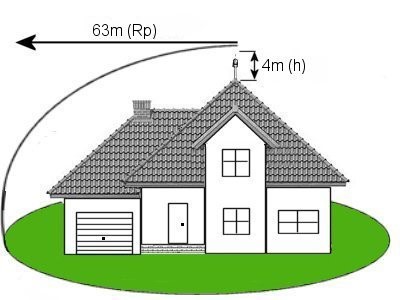
Key takeaway from both cases: Mast height h and certified ΔT both feed directly into Rp. Here, with the same COMET (ΔT = 30µs) and Level III (r = 30m), raising h from 4m to 6m increases Rp from about 54m to 55m per rod; in Case Study 1, two overlapping rods deliver warehouse coverage. Always mount on the tallest practical mast and select a lightning rod with adequate ΔT for the required protection level.
ORBITAL ESE Lightning Rod Selection by Protection Level
All ORBITAL ESE Lightning Rods are independently tested and certified to NFC 17-102. The table below summarises recommended products by protection level and typical application scale.
| Lightning rod | ΔT Value | Max Rp (h=6m)* | Protection Level | Typical Application |
|---|---|---|---|---|
| ZERU ESE Lightning Rod | 60µs | ~107m | I–III | Commercial, schools, medium–large structures |
| COMET ESE Lightning Rod | 30µs | ~72m | II–III | Industrial, commercial, airports |
| HELIA ESE Lightning Rod | 67µs | ~107m | I–II | Large industrial, critical infrastructure |
| CONTRA 30 CESE Lightning Rod | 30µs | ~72m | II–III | Compact masts, telecom, retrofit |
| CONTRA 60 CESE Lightning Rod | 60µs | ~107m | I–II | High-risk industrial, wide-area CESE |
* Max Rp at h = 6m with Level I standard radius r = 60m, rounded to the nearest metre. Values above the NFC 17-102 107m ceiling are shown as ~107m.