

Why Computers Are Especially Vulnerable
Modern computers, servers and networking equipment operate at low voltages — 5V, 12V, 3.3V — with sensitive semiconductor components that are destroyed by transient overvoltages of only a few tens of volts above their rated levels. A lightning-induced surge on a power line can reach several thousand volts. The mismatch is extreme.
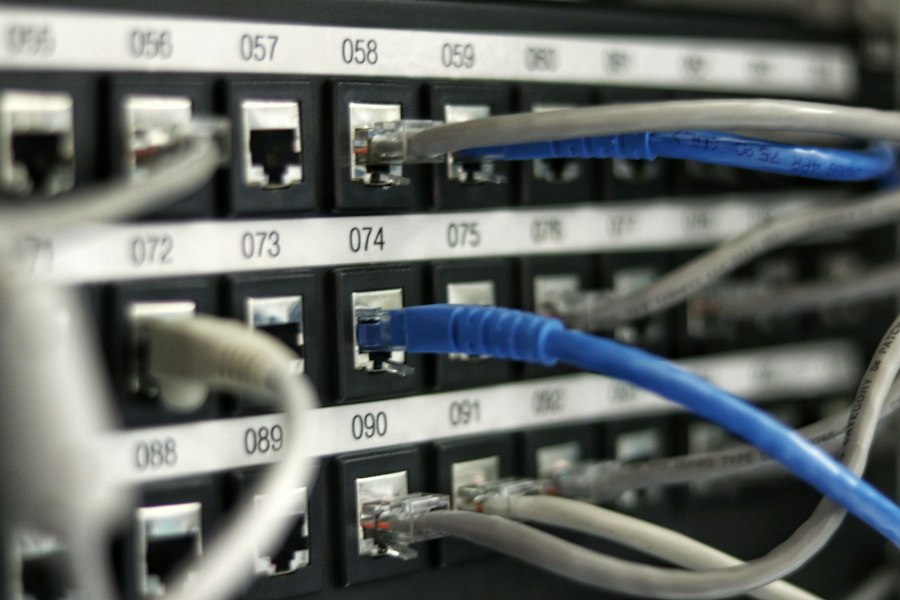
The problem is compounded by the multiple conductive paths that connect most IT equipment to the outside world: the power cable, the ethernet cable, the telephone or DSL line, the HDMI or USB cables to peripherals. Each of these is a potential surge path. Protecting only the power connection while leaving data and communication lines unprotected is a common and expensive mistake.
Step 1 — A Quality Surge Protective Device at the Distribution Board
The most effective protection starts at the point of entry — the main distribution board where the power supply enters the building. A Type 1 or Type 2 SPD installed here intercepts the largest surge components before they reach the building's internal wiring.
For a home or small office, a Type 2 SPD at the distribution board is typically sufficient. For a commercial building, a Type 1 SPD should be installed first, followed by Type 2 devices at sub-distribution boards. This coordinated approach reduces the transient progressively at each stage. For Type 2 boards see OSPD 101 and OSPD 4011-3P; service-entry Type 1 is specified with engineering support.
Step 2 — Point-of-Use Surge Protection
A plug-in surge protection strip at the equipment provides the final layer of point-of-use protection. When selecting one, look for: a low clamping voltage (Up ≤ 1.5kV for sensitive electronics), a status indicator that shows whether the protective components are still functional, and — critically — protection on all ports (power, ethernet, telephone).
Be aware that surge protection strips degrade with each event they absorb. After protecting against a significant surge, the MOV (metal oxide varistor) components inside the strip may be partially or fully exhausted. A strip with a failed MOV provides no protection but may show no external indication of failure. Replace them after any known surge event, or use devices with a built-in "protection active" indicator light.
Important limitation: Point-of-use strips are Type 3 devices. They are designed to handle the residual transient after upstream Type 1 and Type 2 devices have already clamped the surge. Used alone, without upstream protection, they may be overwhelmed by a large surge and fail to protect the equipment.
Step 3 — UPS (Uninterruptible Power Supply)
A UPS device serves two purposes: it provides battery backup power during outages, and — if it incorporates a double-conversion topology — it isolates the connected equipment from the mains supply entirely, providing excellent protection against surges and power quality issues.
Not all UPS devices offer the same surge protection. Line-interactive UPS devices pass mains power through with some conditioning; double-conversion (online) UPS devices reconstruct the output from battery, providing complete electrical isolation. For servers and critical workstations, double-conversion UPS offers the highest level of protection against power quality events.
Step 4 — Disconnect During Severe Storms
No surge protection device is rated for a direct lightning strike on the incoming service. When a severe storm is forecast and the equipment is not in use, unplugging it from all connections — power, ethernet, telephone — removes all conductive paths and eliminates the risk entirely. This is the most reliable protection method available for non-critical office equipment.
Step 5 — Wireless for Low-Risk Connections
A wired ethernet connection between a computer and a modem/router is a direct conductive path for surges. Switching to Wi-Fi removes this path — a surge that destroys the router does not travel wirelessly to the computer. This is a practical mitigation for home and small office environments where a full SPD scheme has not been installed.
The Complete Picture
True protection for a building's IT infrastructure requires a coordinated approach: an external LPS (ESE lightning rod, down conductors, earthing) to intercept direct strikes; Type 1/2 SPDs at the distribution board to handle induced surges on the power supply; SPDs on all data and communication line entries; and point-of-use protection at the equipment itself. This is the lightning protection zone (LPZ) concept defined in IEC 62305-4. See our full engineering guide for the complete explanation.