

Three Parts of a Complete System
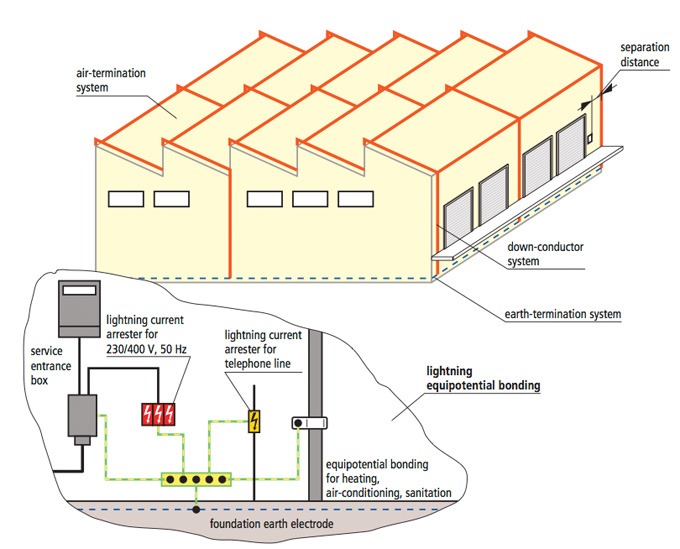
Lightning rods or air terminals are only one part of a full lightning protection system (LPS). In practice, the top terminals may play a smaller role than most people assume. A complete installation is built from three coordinated components:
- Air terminals (rods) — Vertical terminals at roof level that define where the lightning discharge should attach, rather than at a random point on the structure.
- Down conductors — Heavy cables that carry lightning current from the terminals to the ground, routed along the building with minimal bends and adequate cross-section.
- Earth termination — Earth rods or electrode networks buried typically 2–3 m deep, bonded to the down conductors to complete a controlled path around the structure.
The down conductors and earth electrodes do most of the safety-critical work: diverting and transferring the strike current past the building. With good conductor coverage and low-resistance earthing, a properly designed LPS can still perform its essential function even when air-terminal placement is less than ideal — but without earthing, the rest of the system cannot work.
What LPS Does — and What It Does Not
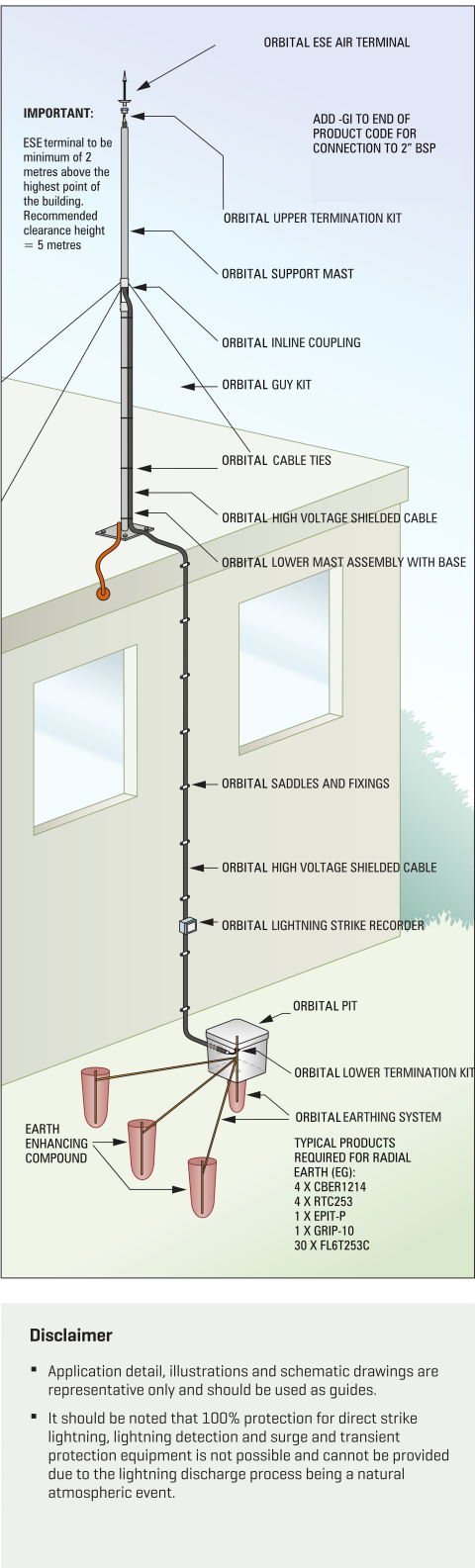
The main goal of an LPS is to protect people and the structure when lightning hits the building directly, by providing a continuous, low-impedance path to ground. Contrary to common myths, lightning protection systems:
- Do not attract lightning to a specific storm cell
- Do not drain or neutralise a thunderstorm by “removing” its charge
- Do not, by themselves, replace coordinated surge protection (SPD) for sensitive electronics
- Do reduce fire risk and structural damage by keeping the hot lightning channel out of walls, roofs and internal metalwork
An LPS does not prevent a strike. It gives the discharge a safer place to go. Terminals, conductors and earth rods work as one workflow so that enormous currents bypass occupied spaces and flammable materials wherever possible.
Without a designed path to earth, lightning uses whatever conductors are available — power and data cabling, water or gas pipes, or the building frame itself. That leads to side flashes, overheated wiring and damage that is often worse than a direct hit on a properly earthed system.
When There Is No Safe Path
If no external LPS is installed, the same current still has to reach ground. It may travel through:
- Electrical circuits — overheating or melting conductors and starting fires along the route
- Side flashes — jumps through rooms or across gaps to better-grounded metal, with injury risk to occupants
- Building fabric — explosive pressure in masonry, shattered glazing and damaged services
- Connected equipment — destruction of appliances and control systems on affected circuits
Adding an LPS does not stop lightning, but it replaces chaotic paths with a single engineered route. For internal protection against induced voltages and nearby strikes, pair the external system with bonding and SPDs — see our guides on how the three LPS components interact and protecting electrical equipment.
Need a workflow drawn for your site? Our engineers provide free consultancy, risk assessment and system layout aligned with ESE and IEC practice.